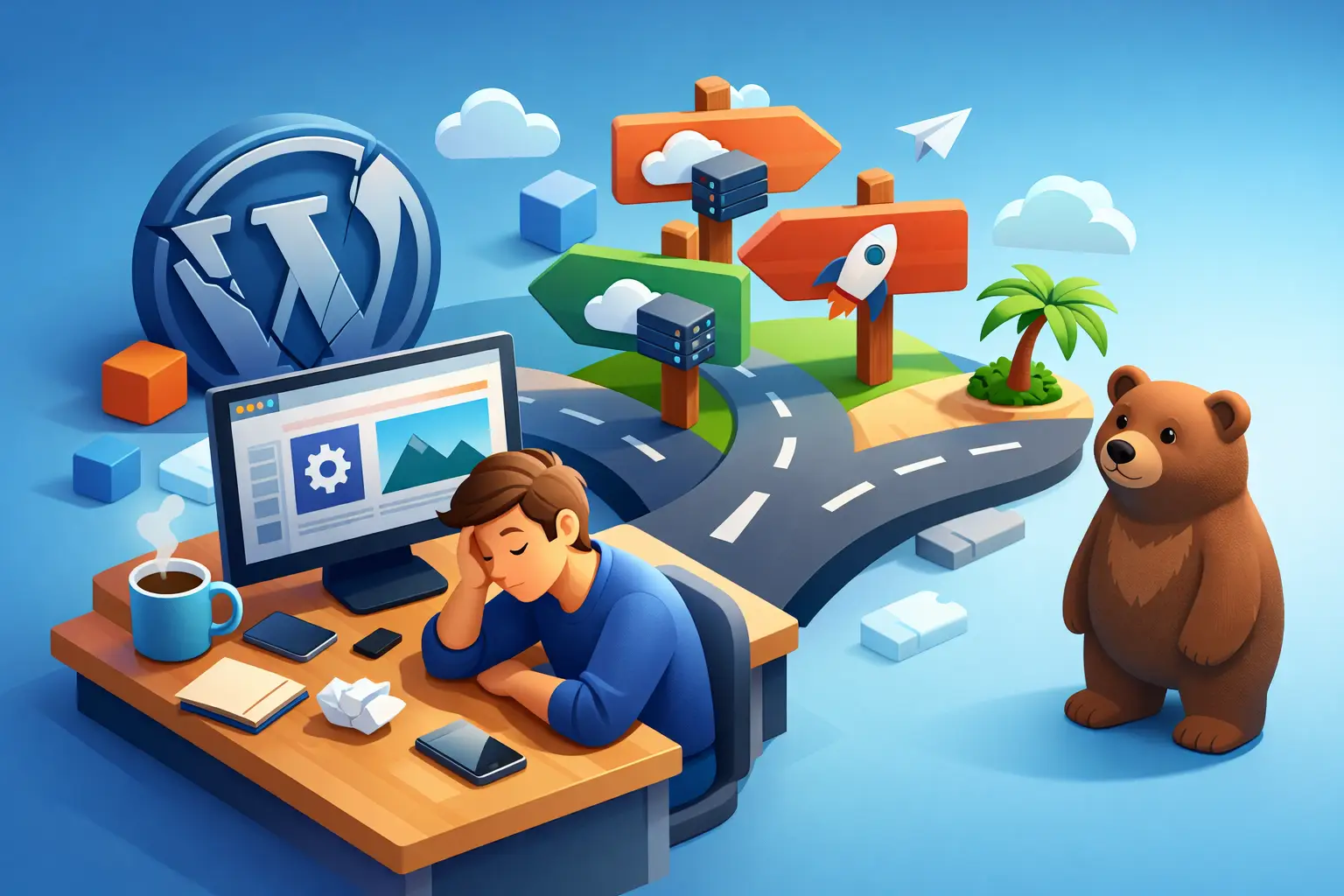
Tired of WordPress? What to Do Next
Tired of WordPress? Learn when to leave it, when to fix it, and what modern website stacks offer businesses that need speed and growth.
When your website feels like a part-time IT job, it stops being a business asset. If you're tired of WordPress, you're usually not tired of one thing. You're tired of plugin conflicts, slow backends, security updates, surprise breakage, and a site that needs constant attention just to stay functional.
That frustration is valid. WordPress still powers a huge share of the web, and for some businesses it remains a practical choice. But if your site is supposed to generate leads, support campaigns, and reflect a serious brand, there comes a point where "good enough" starts costing you real opportunities.
Why businesses get tired of WordPress
Most business owners do not wake up one day and decide they want a different CMS for fun. They get there after months or years of friction.
At first, WordPress often looks efficient. Themes are inexpensive. Plugins promise quick fixes. A developer can get something live fast. That works well enough in the early stage, especially if your needs are simple.
The problem shows up later. Your marketing stack grows. Your site needs custom landing pages, cleaner analytics, better performance, tighter security, and more control over the user experience. Now the same system that felt flexible starts feeling patched together.
One plugin handles forms. Another handles SEO. Another handles caching. Another manages redirects. Another adds custom fields. Each one introduces dependencies, updates, compatibility risk, and a layer of complexity your team did not sign up for.
That is when WordPress becomes less of a platform and more of a maintenance cycle.
Tired of WordPress or tired of a bad setup?
This is the right question to ask before you rebuild anything.
Some companies are not actually tired of WordPress itself. They are tired of a bloated theme, poor development choices, weak hosting, or years of shortcuts. In those cases, a cleanup can solve the problem. A lighter build, fewer plugins, stronger governance, and better hosting can make a major difference.
But sometimes the issue runs deeper. If your business depends on speed, custom workflows, app-like experiences, multi-channel content delivery, or a more modern development process, WordPress may no longer be the right foundation.
That does not mean WordPress is bad. It means your business has outgrown what it does best.
The real cost of staying on a platform that slows you down
A lot of companies keep WordPress because switching feels expensive. That is understandable. Replatforming takes planning, budget, and technical oversight.
What gets ignored is the cost of staying put.
If your site loads slowly, your paid traffic performs worse. If your editors struggle with clunky page builders, content production slows down. If updates keep breaking parts of the site, your team avoids making improvements. If your website cannot support the experience your brand needs, you start looking smaller than you are.
Those are not minor annoyances. They directly affect lead generation, conversion rates, and brand trust.
For growth-focused businesses, the question is not just "What does a rebuild cost?" It is "How much are we losing by keeping a system that fights us every month?"
What modern alternatives do better
When companies move away from WordPress today, they are usually not looking for another all-in-one system with the same weaknesses in a different wrapper. They want a stack built for performance, control, and growth.
That is why newer approaches built with tools like Next.js, headless CMS platforms, and custom web architectures are getting serious attention. They give businesses more freedom to design around user experience instead of theme limitations. They also reduce the plugin sprawl that makes traditional WordPress setups fragile.
A modern stack can improve site speed, strengthen security, and make it easier to scale campaigns, content, and custom functionality. It can also create a better workflow between marketing and development, which matters if your site is a lead engine rather than a digital brochure.
Still, there are trade-offs. A modern stack usually requires stronger technical execution up front. It is not always the cheapest route. And if your business only needs a basic informational site with occasional edits, moving away from WordPress may be unnecessary.
The right move depends on where your business is headed, not just what your site looks like today.
Signs you're truly tired of WordPress for the right reasons
There are a few clear signals that it may be time to move on.
One is when your website is central to revenue, but your platform cannot keep up with marketing demands. Another is when custom features become awkward workarounds instead of clean solutions. A third is when site maintenance absorbs too much time, budget, or internal attention.
You should also take a harder look if performance issues are hurting SEO and paid traffic, or if your team has lost confidence in making routine updates because something always breaks.
At that point, staying with the familiar option may feel safer, but it usually keeps the business stuck.
What to do if you're tired of WordPress
Start with an honest audit. Not a cosmetic review - a business review.
Look at how your current site supports lead generation, content management, search visibility, paid campaigns, and operational efficiency. Identify what is truly broken, what is merely annoying, and what is limiting growth.
Then define what the next platform needs to do. Faster performance is not enough. You should be clear about the outcomes you want: better conversion rates, easier campaign deployment, cleaner integrations, improved editing workflows, stronger security, or room to build custom tools.
From there, compare your options. For some businesses, rebuilding WordPress correctly is the smart move. For others, a headless setup with Next.js and a modern CMS creates far more long-term value. The wrong move is choosing based only on what feels familiar or what looks cheapest in the first meeting.
This is also where the right partner matters. A website rebuild is not just a design project. It affects marketing, development, analytics, paid media performance, SEO, and future scalability. If those pieces are handled separately, the site often ends up looking better without actually performing better.
The platform should fit your growth stage
A small local business with a simple service offering has different needs than a company running aggressive search campaigns, location pages, landing pages, automations, and lead routing.
That sounds obvious, but many businesses are still using the same website structure they chose years ago when their digital strategy was much smaller. The company grows. The marketing grows. The expectations grow. The site stays stuck.
That mismatch creates drag.
If you are investing seriously in digital growth, your website should support that ambition. It should load fast, adapt quickly, integrate cleanly, and give your team confidence. It should not require constant workarounds just to keep up with the business.
Leaving WordPress is not the goal
The goal is to build a site that helps you win.
That might mean staying on WordPress with a much smarter architecture. It might mean moving to a more modern stack entirely. What matters is choosing a system based on business performance, not habit.
The strongest companies treat their website as infrastructure. They do not just ask whether it looks current. They ask whether it helps them dominate online, capture demand, and support the next stage of growth.
If you're tired of WordPress, do not brush that off as a technical complaint. It may be a sign that your business has outgrown the system behind your digital presence.
When that happens, the answer is not to keep patching the same problem. It is to choose a platform that matches your pace, your goals, and the level you want to compete at. If you want help evaluating whether to rebuild, migrate, or modernize your stack, BearSolutions can help you map the right setup and request a call to talk through the next move with clarity.